How much do faceless YouTube channels make?
How much do faceless YouTube channels make? The honest math: RPM by niche, a planning table from 100K to 1M views, and the monetization gate.
"How much do faceless YouTube channels make?" is the most searched question in this space, and the most honestly answered one is: it depends on the niche, and the spread is enormous. A channel in Money & Finance can earn roughly five times more per thousand views than a channel in Sleep & Relaxation. That single variable, niche RPM, swamps almost every other factor in the equation. Before projecting any number, you need to know what RPM your niche actually commands and how the YouTube revenue formula works.
RPM vs CPM: what the numbers actually measure
CPM (cost per mille) is what advertisers pay YouTube for every 1,000 ad impressions. RPM (revenue per mille) is what you, the creator, receive per 1,000 video views after YouTube takes its cut, which is 45%. RPM is therefore always lower than CPM, and it is the number that matters for your income planning. When someone quotes a YouTube earnings figure, always confirm whether they mean CPM or RPM. Using CPM to project creator income overstates it by roughly 80%.
RPM also varies by geography, seasonality, and viewer intent. Advertisers pay more to reach audiences actively making financial decisions, which is why Business & Brands and Geopolitics & Economics command higher rates than entertainment niches. Q4 advertising spend typically pushes RPMs higher across the board; January is usually the lowest month of the year.
The planning formula
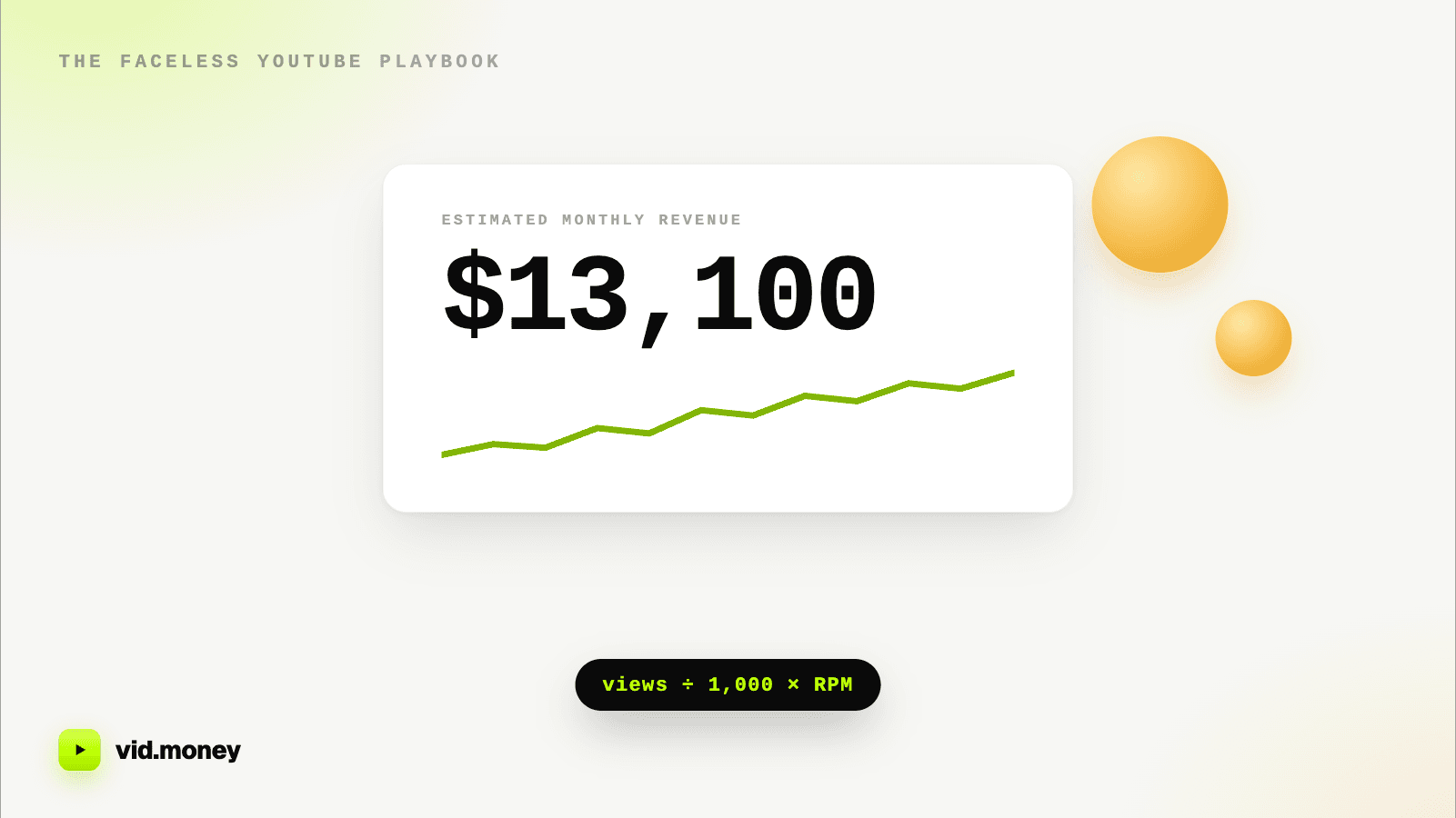
Revenue from AdSense follows one equation: (views / 1,000) multiplied by RPM. That is the entire model. Everything else, upload frequency, thumbnail quality, watch time, is in service of driving views. The RPM values below are planning benchmarks drawn from observed niche averages. Treat them as order-of-magnitude guides, not income guarantees, because individual channel RPMs fluctuate based on audience location, video length, and ad density.
The planning table: three niches, three view milestones
The table below works through the formula at 100K, 500K, and 1M monthly views for three niche tiers. All figures are planning estimates only. Each tier reflects a distinct audience intent and advertiser category, which is why the revenue spread between them is so wide even at identical view counts.
- Money & Finance at $22 RPM: 100K views = $2,200 | 500K views = $11,000 | 1M views = $22,000
- History at $10 RPM: 100K views = $1,000 | 500K views = $5,000 | 1M views = $10,000
- Sleep & Relaxation at $4 RPM: 100K views = $400 | 500K views = $2,000 | 1M views = $4,000
The gap between the top and bottom tier at 1M views is $18,000 per month. That is not a marginal difference; it is a business model difference. A channel that reaches 500K monthly views in Money & Finance earns more than a channel that reaches 1M views in Sleep & Relaxation. Niche selection is therefore the highest-leverage decision a faceless channel operator makes, before content quality, before upload frequency, before anything else. The niche catalog lists RPM benchmarks across 24 categories if you want to compare more options.
The monetization gate: 1,000 subscribers and 4,000 watch hours
YouTube requires 1,000 subscribers and 4,000 public watch hours in the past 12 months before a channel can join the YouTube Partner Program and enable AdSense. Until you cross both thresholds, views generate no direct ad revenue. This is where long-form video has a structural advantage over Shorts.
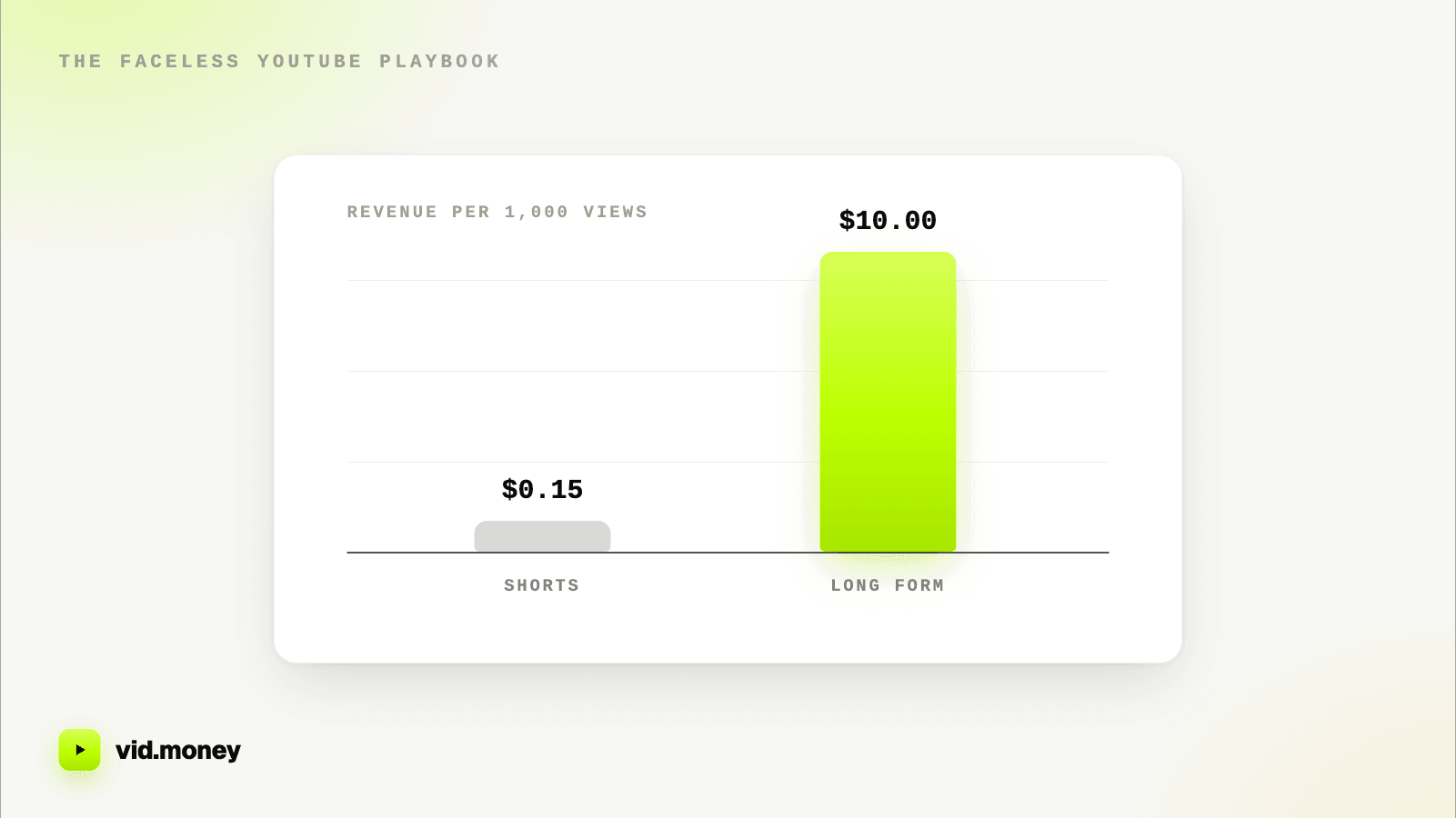
A 15-minute video watched to completion contributes 15 minutes toward the 4,000-hour requirement. A 60-second Short watched to completion contributes one minute. To accumulate 4,000 hours (240,000 minutes) purely from Shorts, you need roughly 240,000 full completions, whereas a catalog of long-form videos earning average watch times of even 6 to 8 minutes closes that gap far faster. Long-form also adds mid-roll ad placements on videos 8 minutes or longer, which adds placement inventory beyond a single pre-roll. For a detailed comparison of the RPM math between formats, see long-form vs Shorts RPM math.
The cost side: break-even views per video
Producing a finished long-form faceless video with vid.money costs between $17 and $25 per video depending on the credit pack you choose. That is a fixed per-video cost with no subscription and no expiry on credits. The break-even view count, the number of views a single video needs to recoup its production cost, is straightforward to calculate.
- Money & Finance ($22 RPM): a $25 video breaks even at roughly 1,140 views
- History ($10 RPM): a $25 video breaks even at roughly 2,500 views
- Tech & AI ($15 RPM): a $25 video breaks even at roughly 1,667 views
- Psychology ($12 RPM): a $25 video breaks even at roughly 2,083 views
- Sleep & Relaxation ($4 RPM): a $25 video breaks even at roughly 6,250 views
At the $17 minimum (25-pack), break-even drops to under 775 views for a Money & Finance video. Even a modest video in a high-RPM niche that earns a few thousand views in its lifetime covers costs many times over. The math tightens in low-RPM niches, which is another reason niche selection is a financial decision, not just a content preference.
Archive compounding: why consistency multiplies everything
A single video earns views at launch, then continues earning at a lower rate for months or years as it surfaces in search and suggested feeds. The total earnings of a channel are not just the sum of each video's launch performance; they are the sum of every video's ongoing tail. A channel with 50 videos in the catalog earns from 50 simultaneous streams, not one. A channel with 200 videos earns from 200.
This is the compounding effect that operators who focus only on launch-week metrics consistently underestimate. Uploading one well-researched video per week for a year produces a 52-video archive. If each video averages even 3,000 views per month in steady state after its first month, that archive generates 156,000 monthly views before a single new video is published. At $22 RPM, that is over $3,400 per month from catalog alone. The 2026 faceless workflow guide covers how to build a consistent upload process without burning out on production.
Consistency also signals reliability to YouTube's recommendation algorithm. Channels that publish regularly tend to have their newer videos surfaced more aggressively than dormant channels publishing sporadically. The combination of catalog depth and algorithmic favor is what separates channels that plateau at 50K monthly views from those that grow past 500K.
Choosing the right niche before you start
RPM benchmarks are one input into niche selection; competition and demand are the other two. A niche with a $22 RPM but dominated by established channels with millions of subscribers is a harder entry point than a $15 RPM niche with clear gaps in the content landscape. Topic Finder, included with every vid.money account, scans current YouTube performance data and scores topics by demand, momentum, and competition so you can identify where the opportunity actually sits rather than guessing. The niche selection guide walks through how to weigh these factors together.
What these numbers are not
Everything above is planning math, not a promise. Real channel RPMs vary based on where your viewers are located (US and UK audiences command higher advertiser rates than global averages), the time of year, the specific topics within a niche, ad blocker penetration, and YouTube's own policy decisions about ad inventory. The RPM benchmarks in this article represent observed niche averages and are useful for comparing niches against each other and for sizing rough revenue potential. They are not guarantees of what any specific channel will earn.
Similarly, the view milestones in the planning table (100K, 500K, 1M monthly views) are not targets with predictable timelines. Some channels reach 100K monthly views in three months; others take two years with similar content quality and upload schedules. Growth rate depends on niche competition, video quality, topic selection, and distribution patterns that vary enormously across channels.
Use the formula to make better decisions about niche selection and content investment. Do not use it to project a personal income timeline. The operators who build durable faceless channel businesses are the ones who run consistent operations over 12 to 24 months, not the ones who optimize for a particular revenue number in month three.
Ready to start?
Turn any topic into a finished faceless YouTube video.
vid.money handles research, script, narration, visuals and the final edit. You pick the topics and press upload.
Make my first video