YouTube automation: what it actually is in 2026
YouTube automation means delegating production, not skipping work. Here is an honest definition, a cost breakdown, and what to expect in your first 90 days.
YouTube automation gets sold as passive income and described as a scam in equal measure. Neither framing is accurate. At its core, youtube automation means running a channel where the production work is delegated to a combination of tools and freelancers rather than done by the operator personally. The channel still needs a human at the wheel making judgment calls. The work doesn't disappear; it shifts.
YouTube automation defined: what the term actually covers
The phrase became popular around 2019 and 2020 when a cluster of YouTube courses started promoting the idea that you could build a faceless channel, hire out every step, and collect ad revenue without touching the content yourself. The label stuck even as the tools evolved. Today it covers a wide range of approaches: fully outsourced channels where a team handles everything, hybrid setups where an operator uses AI tools for production and makes decisions themselves, and everything in between.
What all of these have in common is that the person running the channel does not appear on camera and does not personally script, narrate, or edit the videos. That is the actual definition. Everything else, including how much of the work is done by tools versus people, and how passive the income really is, varies enormously.
Which production steps you can automate in 2026
Production has genuinely become automatable in 2026 in a way it wasn't three years ago. The maturation of AI voice generation, AI-assisted video editing, and smarter topic research tools has collapsed what used to require a small team into a single workflow. The following steps can now be handled by tools rather than freelancers, and the quality gap between tool output and human output has narrowed to the point where it no longer disqualifies tool-first channels from competing:
- Topic research: tools like the Topic Finder scan what is currently working on YouTube and score topics by demand, momentum, and competition, cutting what used to be hours of manual research to minutes.
- Script writing: AI can produce a structured, narrated long-form script from a one-sentence brief.
- Narration: AI voice generation has reached a quality level that passes comfortably for most faceless niches.
- Visuals and B-roll: stock footage libraries and AI image generation handle most of what an editor would previously source manually.
- Subtitles and the final edit: end-to-end tools now deliver a finished video, subtitles and music included, without a human editor touching a timeline.
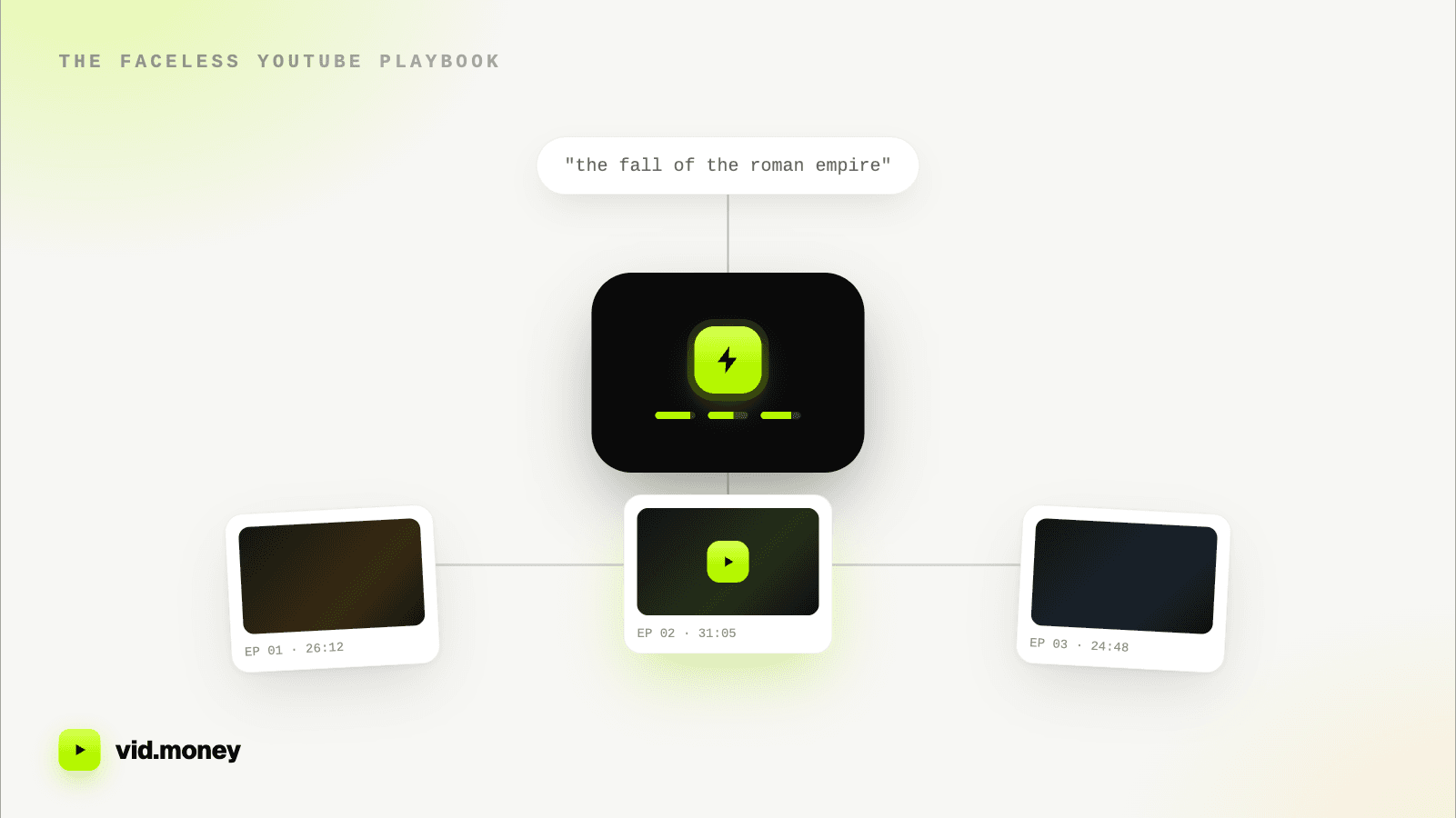
A tool like vid.money handles all of these in a single step: you type one sentence, pick a length, and receive a finished long-form video with script, AI narration, visuals, subtitles, and music. That is the production stack collapsed into one credit.
What still requires a human operator
This is where most automation content goes quiet, because the honest answer is that the strategic layer of running a channel is not automatable and probably never will be. Strategy, judgment, and distribution all require context a tool cannot hold. The decisions that determine whether a channel grows or stalls are the ones made by a person, not generated by software.
- Niche selection: choosing a niche that fits your budget, your timeline, and the revenue potential you are targeting requires judgment, not just data. The numbers help; the call is yours. A good starting point is the niche picking guide.
- Topic judgment: even with a scored topic list in front of you, deciding which idea is right for your audience at this moment requires a read of your channel's context that a tool cannot supply.
- Titles and thumbnails: a title is a promise to a potential viewer. Getting it right is closer to copywriting than to automation. Thumbnails, which you create yourself and upload alongside the video, are one of the highest-leverage decisions you will make per video.
- Reading analytics: understanding why a video underperformed, or why one held watch time unusually well, requires interpretation. The data is the raw material; the insight is yours.
- Uploading: you upload the finished video yourself. No tool in this stack does that for you, and you should be skeptical of anyone who implies otherwise.
Most operators underestimate the strategy budget. The workflow, from topic selection through upload, is documented in detail in the 2026 faceless workflow post. The short version: plan to spend real time on strategy and distribution even when production is handled by tools.
The real cost: freelancer stack vs AI tools
Before AI production tools matured, the standard "automated" channel used a freelancer stack: a scriptwriter, a voice artist, a video editor, a thumbnail designer. Rates vary widely by quality tier and platform, and the per-video cost adds up quickly when you account for multiple rounds of revision and the overhead of coordinating several different contractors. For a channel posting consistently, those costs compound into a meaningful production budget before the channel has earned anything.
The alternative is an AI-first production stack. At vid.money's pricing, one finished long-form video costs between $17 and $25 depending on the pack you choose. Credits never expire. There is no subscription. That changes the math for operators who are building before they are earning, which is the situation every new channel is in.
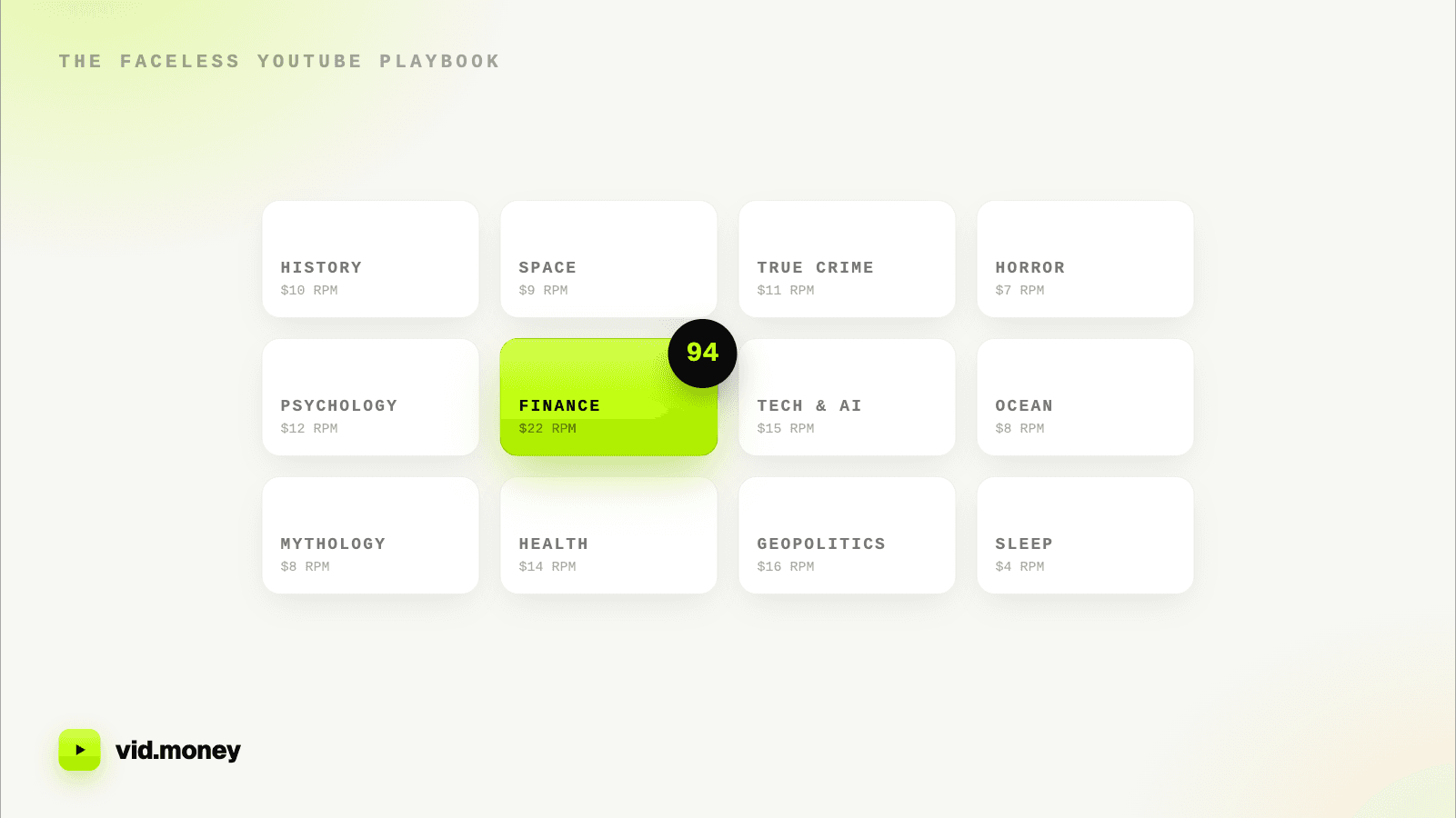
The comparison is not purely about cost. A freelancer stack gives you more granular control over each element; an AI tool gives you speed and a lower floor. For most operators starting out, the AI stack is the right default until the channel is generating enough revenue to justify upgrading specific components. The niche RPM data at vid.money can help you model when that crossover happens for your specific niche.
Guru red flags to know before you spend money
The YouTube automation space has a significant amount of course content that overpromises. Recognizing the patterns before you spend anything is worth more than the list that follows. These are the signals worth being suspicious of:
- Anyone selling "fully passive" income from a YouTube channel. A channel requires ongoing decisions and maintenance. Passive describes a matured, stable channel at best, and even then it drifts without attention.
- Anyone promising specific earnings. RPM data is useful for planning, not for guarantees. Your actual revenue depends on your niche, your watch time, your audience geography, and factors that no course can control.
- "Copy-paste" channel models. The specific angle and positioning of a channel is a competitive asset. A template that worked for someone else in 2022 is not a strategy for you in 2026.
- Courses priced higher than a meaningful production budget. If you are spending more on a course about YouTube automation than you would spend producing your first ten videos, the incentives are misaligned.
- Screenshots of AdSense dashboards as proof. A screenshot proves nothing about the work required, the niche, the timeline, or whether those numbers are repeatable.
The RPM figures published for planning purposes across the vid.money niche directory are the kind of data you should be working with: transparent, sourced, and framed as planning math rather than income promises. It won't tell you what you will earn; it will tell you what you are aiming at.
What a realistic first 90 days actually looks like
This section contains no earnings claims, because making them would be dishonest. What follows is an effort-level description, not a revenue projection. The arc runs from picking a niche and building your first videos through to the point where you have enough data to iterate and a clear line of sight to the YouTube Partner Program's 1,000 subscriber and 4,000 watch-hour thresholds.
Month one is almost entirely setup and learning. You pick a niche, which takes more research than most people expect if you do it seriously. You define a content angle within that niche. You build your first three to five videos and upload them, learning how long each step actually takes you and where the bottlenecks are. You set up basic channel branding. You start to understand what the analytics are telling you, even though there is not yet enough data to be confident in any interpretation. At the end of month one, you have a small library and a baseline.
Month two is iteration. You post more consistently. You start A/B testing title approaches on new uploads. You identify your one or two best-performing videos and study what made them land better than the others. You may adjust your topic selection based on early watch-time signals. The YouTube algorithm begins to get a clearer picture of who your audience is. You are nowhere near the 1,000 subscriber and 4,000 watch-hour thresholds required for the YouTube Partner Program yet, but the gap is now a number you can track rather than an abstraction.
Month three is where consistency compounds. Channels that maintain a regular cadence into month three tend to be in a much better position than those that posted aggressively in month one and then tapered off. You may be approaching, or in some niches crossing, the YPP thresholds by the end of this period, though this depends entirely on your niche, your posting frequency, and how well your titles and thumbnails are performing.
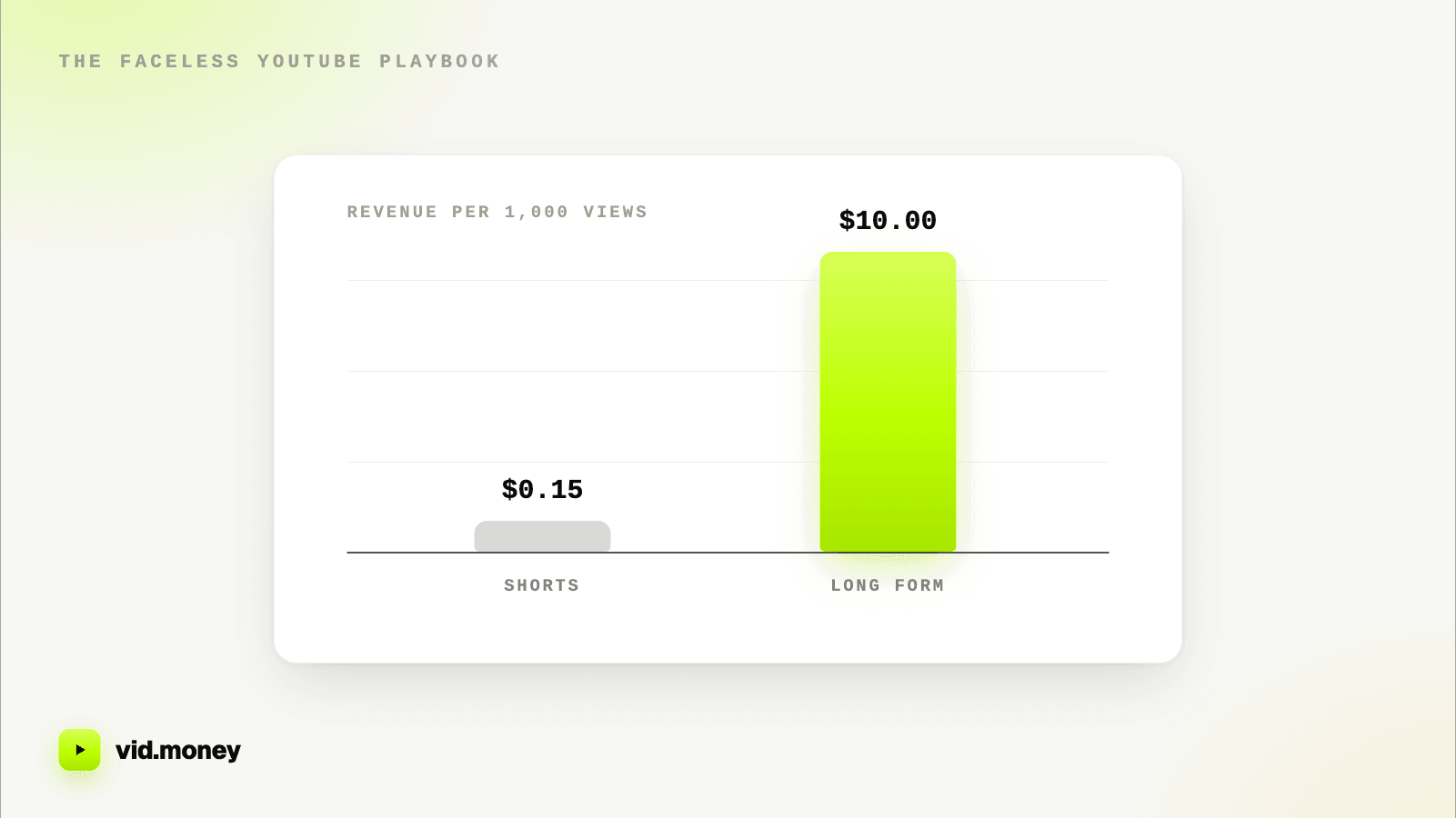
The 90-day picture requires a real but manageable time commitment from an operator using a tool-first production stack: time split across topic research, reviewing generated videos, writing and testing titles, creating thumbnails, uploading, and reading analytics. That is not passive. It is a part-time workload with a specific skill set. It is also meaningfully less than running a freelancer stack would require in coordination overhead alone. See the long-form vs Shorts RPM math for how to think about the revenue side as you approach eligibility.
YouTube automation, done honestly, is a production delegation strategy, not a get-rich scheme. The channels that work are operated by people who treat them as a real business with a low production cost floor rather than a machine that runs itself. That reframe is worth holding onto before you post your first video.
Ready to start?
Turn any topic into a finished faceless YouTube video.
vid.money handles research, script, narration, visuals and the final edit. You pick the topics and press upload.
Make my first video